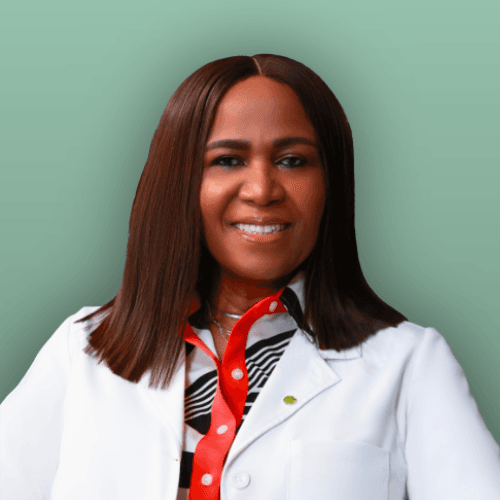
Ogomegbunam Ogbonna
she/herPsychiatric Mental Health Nurse Practitioner (PMHNP)

 Board certified
 Anxiety, Depression, Bipolar Disorder, Trauma / PTSD
Self pay costs
Out-of-pocket session costs for clients who don’t have insurance or aren’t covered by their insurance for mental health services.
I am Ogo Ogbonna, a dual board-certified nurse practitioner in family practice (FNP-C) and psychiatric mental health (PMHNP-BC). I started my career as a registered nurse across medical-surgical and psychiatric settings — those years taught me healing is about the whole person, not just the body. I specialize in depression, anxiety, bipolar disorder, ADHD, trauma, and the psychiatric impact of chronic illness, including patients whose unexplained physical symptoms have gone unresolved despite multiple evaluations. My dual training gives me the lens to see what others sometimes miss: the body and the mind are always in conversation.
My approach combines evidence-based psychiatric care with real human connection — medication management alone is never the whole answer. I use a collaborative, trauma-informed framework focused on root causes, not surface-level symptoms. I build relationships grounded in trust and mutual respect, because progress requires feeling safe enough to be honest.
If you have been telling yourself you are too busy, too strong, or that others have it worse — I want to gently challenge that thought. Your pain is real, and you deserve the same care you give to everyone else. Healing does not require figuring everything out first. One courageous decision to show up is all it takes. I would be honored to help you get there

"As a dual board-certified Nurse Practitioner with over a decade of experience bridging physical and mental health, I believe that true healing begins when patients feel genuinely seen, heard, and supported and that is the standard I bring to every single visit. "
Why did you decide to become a counselor or psychiatric provider?
Honestly, because I kept watching people suffer in silence and I could not look away. Early in my career as a Registered Nurse I worked on psychiatric units and saw incredibly hardworking, loving people mothers, fathers, teenagers, professionals who had spent years convincing everyone around them that they were fine. They were not fine. They were exhausted from pretending. They had headaches that never went away, stomachs always in knots, sleep that never came and underneath all of those physical complaints was a mental health condition that had never once been addressed. The barrier was never access. It was stigma. People would rather accept a physical diagnosis than admit they were struggling emotionally because somewhere along the way the world had taught them that mental health was a weakness instead of a medical reality. That made me angry. And that anger became my purpose. When I moved into advanced practice as an FNP I kept seeing the same pattern depression masking as fatigue, anxiety as chest pain, trauma as chronic illness. I realized I needed more tools to truly help my patients. Pursuing my PMHNP was not just a career decision it was a calling. Psychiatric care requires you to be fully present to listen to what is said, what is not said, and everything in between. That suits me perfectly. I go above and beyond for every patient because I genuinely cannot rest knowing someone left my care without feeling truly seen, heard, and supported. I chose psychiatry because it matters and because every patient deserves a provider who shows up for them with their whole heart.
What types of clients do you work best with?
I work best with people who are ready to be honest even if they are scared. They do not have to have everything figured out. They do not need to walk in with a neat summary of their symptoms or a clear idea of what they need. They just have to be willing to show up and tell me the truth about what they are experiencing. I will take it from there. The patients I connect with most deeply are the ones who have been carrying their struggles quietly for a long time. The high-functioning professional who looks completely put together on the outside but is barely holding it together on the inside. The teenager who is acting out or shutting down and nobody has stopped long enough to ask why. The parent who has spent so long taking care of everyone else that they have completely forgotten to take care of themselves. The person who has seen multiple providers, been told their labs are normal, and is starting to wonder if they are imagining the whole thing they are not, and I love being the provider who finally helps them connect the dots. I also work really well with patients who have had bad experiences with the healthcare system people who felt dismissed, rushed, or over-medicated without explanation. Those patients come in with their guard up, and honestly I understand why. My job in those first visits is not to push, it is to earn their trust. And I take that seriously. I work with adolescents, adults, and older adults navigating depression, anxiety, bipolar disorder, ADHD, trauma, and the emotional weight of living with chronic illness. I have a special place in my heart for patients who present with unexplained physical symptoms because I know from experience that what looks like a physical problem is often a mental health condition waiting to be recognized and treated. What I will tell you is this, I do not do well with complacency. I am not the right fit for someone who wants to be handed a prescription with no conversation, no followup, and no plan. I believe in partnership. I believe in showing up fully for every single patient. And I work best with people who, even in their most broken moments, still have a small part of them that believes things can get better because I will hold onto that belief with them until they can hold it on their own.
What's one thing you wish all clients knew about therapy, mental health, or the healing process?
I will let my patients know that asking for help is not weakness it is one of the bravest things a human being can do. So many patients arrive carrying invisible shame, feeling like they should have figured this out on their own. I want to look at every single one of them in the eye and say you are not broken. You are human. And you deserve support just as much as anyone else. The other thing I wish everyone understood is that healing is not a straight line. It is messy. It has good weeks and hard weeks. Progress does not always look dramatic sometimes it looks like sleeping through the night for the first time in months, laughing and actually meaning it, or simply feeling like yourself again for one afternoon. Those moments matter enormously and they are worth celebrating. Mental health is not something you fix once and move on from. It is something you tend to consistently just like any other chronic condition. I would never tell a diabetic patient to push through without insulin. Mental health deserves that same level of respect and consistent care. And if you have been putting off getting help because of what someone might think I want you to know that you are worth far more than other people's opinions. You deserve to feel well. And taking that first step toward healing is the most powerful gift you will ever give yourself.
What can clients expect in their first session with you and in the early stages of therapy?
They can expect to feel like they finally have someone in their corner. The first session is never about rushing to a diagnosis or pulling out a prescription pad. It is about getting to know you, the real you, not just your symptoms. I want to understand your story. What has your life looked like? What brought you to this point? What does feeling better actually mean to you? Those answers shape everything we do together going forward. I ask a lot of questions in those early sessions because the details matter to me. I am the provider who notices things the way you describe your sleep, the physical complaints that keep showing up alongside the emotional ones, the things you mention casually that are actually anything but casual. I pay attention to all of it because all of it tells me something important about how I can best help you. I also want patients to know that the first session is a two-way street. I am assessing you clinically but I want you to assess me too. Do you feel heard? Do you feel safe enough to be honest? If something does not feel right, tell me. This only works when there is genuine trust on both sides. In the early stages I move deliberately building a clear foundation before layering in treatment. By the time we are a few sessions in, my goal is simple, I want you to feel safer, more hopeful, and absolutely certain that showing up was the right decision.
What personal experiences or values inform your practice as a therapist/provider?
Growing up I watched people in my community dismiss mental health struggles as something you just prayed through, pushed through, or kept hidden from the world. Seeking help was seen as weakness. Struggling emotionally was something you handled privately or not at all. That experience never left me. If anything it lit a fire in me that has never gone out. When I became a nurse and started working on psychiatric units I saw that same pattern playing out in clinical settings people arriving in crisis because they had waited far too long, because stigma had convinced them their pain was not valid or serious enough to deserve attention. That broke my heart every single time. And it made me more determined than ever to be the kind of provider who makes people feel that their mental health is not just valid it is a priority. My core values are simple honesty, compassion, and excellence. I believe in telling patients the truth, even when it is hard, because I respect them too much to sugarcoat their situation. I believe in treating every single person who comes to me with the same level of warmth and attention regardless of their background, their diagnosis, or their story. And I believe in always giving my absolute best not because someone is watching, but because my patients deserve nothing less. I also carry with me the memory of every patient who trusted me during their most vulnerable moment. That is not something I take lightly. It is something I carry with me into every session, every treatment decision, and every conversation as a reminder of why this work matters and why I will never stop showing up fully for the people in my care.
How do you tailor therapy to meet each client’s unique needs?
Simple, I actually listen. Not just to what you are saying, but to what you are not saying. And I never assume that what worked for my last patient will work for you. Every person who walks into my care comes with a completely unique set of experiences, cultural backgrounds, belief systems, and life circumstances. A treatment plan that ignores those things is not a treatment plan, it is a template. And I do not do templates. From the very first session I am gathering information that goes far beyond symptoms and diagnoses. I want to know about your relationships, your daily routine, your support system, your cultural background, your spiritual beliefs, your previous experiences with healthcare, and what has and has not worked for you in the past. All of that informs how I approach your care, the language I use, the interventions I recommend, the pace at which we move, and the goals we set together. For some patients the priority is medication stabilization first, getting them to a baseline where they can function and engage meaningfully in their own healing. For others therapy and lifestyle modifications are the foundation and medication plays a supporting role. For many it is a carefully balanced combination of both. I do not have a default setting. I follow the patient. I also check in regularly because what a patient needs in month one is rarely exactly what they need in month six. I adjust, I reassess, and I stay flexible. If something is not working I say so honestly and we change course together. My patients are never just along for the ride, they are active partners in every decision we make. At the end of the day tailoring care is not a clinical technique for me it is a reflection of how much I respect the person sitting across from me. You are not your diagnosis. You are a whole person. And you deserve care that treats you exactly that way.
- Years in practice
- 11 years
- Graduating institute
- Liberty University Lynchburg, VA
- Graduating degree
- Psychiatric Mental Health Nurse Practitioner