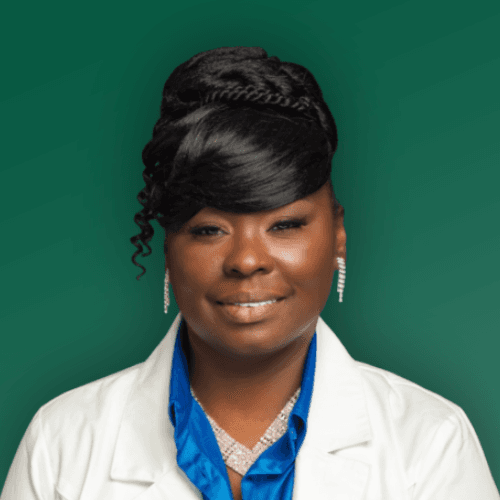
Leona Allen
she/herPsychiatric Mental Health Nurse Practitioner (PMHNP)

 Board certified
 Self Esteem, Sleep / Insomnia, Grief, Depression, Anxiety
Self pay costs
Out-of-pocket session costs for clients who don’t have insurance or aren’t covered by their insurance for mental health services.
I am Leona Allen, APRN, PMHNP-BC, a board-certified psychiatric-mental health nurse practitioner providing comprehensive psychiatric care across inpatient, outpatient, and partial hospitalization settings. Currently completing my Doctor of Nursing Practice (DNP) at Wilkes University, my advanced training and clinical background focus on combining evidence-based psychopharmacology with holistic, patient-centered counseling. My doctoral scholarly project concentrates on optimizing medical coordination, discharge planning, and health literacy for individuals in residential recovery environments.
My clinical approach centers on a collaborative, measurement-based model that treats you as a whole person, not just a collection of symptoms. I integrate precise psychopharmacology with holistic counseling, tailoring every treatment plan to your unique physical, emotional, and social health. I track your progress to ensure our work aligns with your goals.
Taking the first step toward mental health support can feel overwhelming, but you do not have to navigate this path alone. Your story, your challenges, and your goals deserve a space where you are truly heard and supported. When you feel ready to take that next step, I welcome the opportunity to walk alongside you on your journey toward lasting wellness.


"As a board-certified psychiatric mental health nurse practitioner, I am dedicated to providing compassionate, evidence-based care across outpatient, inpatient, and partial hospitalization settings by combining holistic patient counseling with tailored psychiatric care to meet your unique needs."
Why did you decide to become a counselor or psychiatric provider?
I decided to enter psychiatric care because I saw a profound need for care that treats the whole person—not just a list of symptoms or a diagnosis. Throughout my work across inpatient, partial hospitalization, and outpatient settings, it became clear that real healing happens when advanced clinical knowledge is paired with genuine human connection and clear communication. I was particularly drawn to bridging the gaps that people experience during vulnerable transitions, such as moving out of residential recovery or managing complex mental health challenges. Seeing how tailored, evidence-based psychopharmacology combined with compassionate, holistic counseling can empower people to regain emotional balance and reshape their lives inspired me to pursue advanced practice and my doctoral work in nursing practice. Ultimately, I became a provider to offer patients an empathetic, steady partner—someone who listens deeply, honors their unique story, and helps them build a clear path toward lasting stability and wellness.
What types of clients do you work best with?
I work best with clients who are seeking an active, collaborative partner in their mental health journey—people who want a care plan that addresses the whole person, rather than relying solely on medication management. In my practice across inpatient, partial hospitalization, and outpatient settings, I am particularly suited for: Individuals Navigating Complex Transitions: Adults transitioning out of residential recovery, intensive treatment programs, or hospitalization who need structured support, clear medical coordination, and tailored discharge planning to maintain their progress. Adults with Co-Occurring Challenges: Clients managing mood disorders, anxiety, trauma, or substance use recovery who benefit from a dual approach of evidence-based psychopharmacology and holistic counseling. Clients Seeking MeasurementBased Care: Individuals who want to track their growth objectively, break down health information into practical steps, and actively adjust treatment based on measurable outcomes. People Who Value Interprofessional Collaboration: Clients who benefit from a unified team approach, where I coordinate closely with therapists, primary care doctors, and support systems to ensure continuity of care. Ultimately, I thrive with clients who are ready to engage in a nonjudgmental, empathetic space to build long-term resilience, regain emotional balance, and achieve sustainable wellness.
What's one thing you wish all clients knew about therapy, mental health, or the healing process?
I wish every client knew that healing is rarely a linear path, and asking for support is an act of selfadvocacy rather than a sign of weakness. Progress in mental health often happens in small, everyday shifts rather than sudden, dramatic breakthroughs. There will be weeks of steady momentum, moments of plateaus, and times when old patterns briefly resurface—and that is a completely normal part of the process. Sustainable healing isn't about eliminating every challenge or symptom overnight; it's about building your internal resilience, deepening your self-awareness, and equipping yourself with practical tools so you can navigate life's inevitable ups and downs with greater ease and self-compassion. You don't have to have everything figured out before you seek care, nor do you have to carry the weight of recovery alone. Healing is a collaborative, evolving journey, and taking that first step just as you are is always enough.
What can clients expect in their first session with you and in the early stages of therapy?
In your first session, our primary focus is on building a comfortable, non-judgmental space where you feel heard, respected, and understood. Rather than jumping straight into quick solutions, this initial meeting is a thorough evaluation and collaborative conversation designed to map out where you are and where you want to go. Here is what you can expect in that initial appointment and the early stages of care: Your First Session: Assessment & Connection Understanding Your Story: We will discuss what brings you to care, your current symptoms, past experiences with mental health, and any physical or lifestyle factors that might be impacting your wellbeing. Reviewing Health & Background: We will look at your relevant medical history, medications, and lifestyle habits to ensure we view your care through a whole-person, holistic lens. Clarifying Your Goals: We will identify what meaningful progress looks like to you—whether that is managing anxiety, navigating a life transition, or establishing stability in recovery. Addressing Questions: You will have dedicated time to ask about my clinical approach, how psychopharmacology and holistic counseling work together, and what to expect moving forward. The Early Stages: Building Momentum Collaborative Treatment Planning: Based on our first assessment, we will co-create a personalized treatment plan that fits your unique needs and preferences. Measurement-Based Tracking: We will establish clear ways to track your symptoms and progress over time, ensuring our approach remains objective, effective, and flexible. Establishing Consistency: Early sessions focus on setting up practical coping strategies, clarifying care coordination with your other providers if needed, and fine-tuning your plan as we gather more insights. Above all, the early phase of care is about pacing. We work at a speed that feels safe and manageable for you, laying a solid foundation for long-term resilience and health.
What personal experiences or values inform your practice as a therapist/provider?
My practice as a psychiatric nurse practitioner is grounded in the fundamental belief that true mental healthcare must treat the whole person, not just a set of symptoms. Early in my clinical experience across inpatient, partial hospitalization, and outpatient settings, I witnessed how easily individuals—especially those navigating complex health conditions, substance use recovery, or major life transitions—can feel lost in fragmented healthcare systems. Seeing these gaps firsthand shaped my core values: empathy, relational coordination, and patient empowerment. Core Values & Personal Framework Holistic & Integrated Care: I believe mental, physical, and social health are deeply interconnected. My approach looks beyond basic symptom management to consider how medical history, personal goals, and daily environment impact your emotional well-being. Collaboration & Respect: You are the expert on your own lived experience. I view our relationship as an equal partnership where your preferences, values, and personal story guide every clinical decision we make together. Clear Communication & Literacy: Healthcare can often feel overly complex. I value breaking down clinical information into clear, actionable steps so you feel fully informed and in control of your treatment path. Advocacy in Care Transitions: My clinical focus on medical coordination and health literacy stems from a deep commitment to supporting people during their most vulnerable moments—ensuring smooth transitions between care levels so no one falls through the cracks. Ultimately, my work is driven by the belief that with the right support, structured tools, and an empathetic advocate in your corner, sustainable healing and resilience are well within reach.
How do you tailor therapy to meet each client’s unique needs?
Tailoring psychiatric care requires moving away from a one-size-fitsall approach and viewing your mental health through a wholeperson, dynamic lens. Because no two individuals experience mental health challenges in the exact same way, I customize our work together through four foundational pillars: * **Comprehensive, Whole-Person Assessment:** I take the time to evaluate all aspects of your life—including your medical history, psychological well-being, lifestyle habits, personal goals, and social environment. This ensures your treatment plan reflects your complete picture, not just a surface-level list of symptoms. * **Integrative Treatment Strategies:** I blend evidencebased psychopharmacology with holistic, patient-centered counseling. Depending on your needs, our plan might focus on fine-tuning medication, building practical coping mechanisms, focusing on health literacy and psychoeducation, or coordinating with your existing medical and therapy providers. * **Measurement-Based Care & Regular Check-Ins:** We track your progress using objective measurement tools to monitor how well interventions are working. This allows us to make informed, realtime adjustments based on what you are actually experiencing dayto-day. * **Shared Decision-Making:** You are the expert on your own lived experience. Every recommendation—whether introducing a therapeutic technique or considering a medication adjustment—is a collaborative conversation where your preferences, values, and level of comfort guide the outcome.
- Years in practice
- 2 years
- Graduating institute
- AGPCNP-BC, Nursing Education
- Graduating degree
- Wilkes University